Roof Leak and Ice Dam Water Damage in Newport, RI
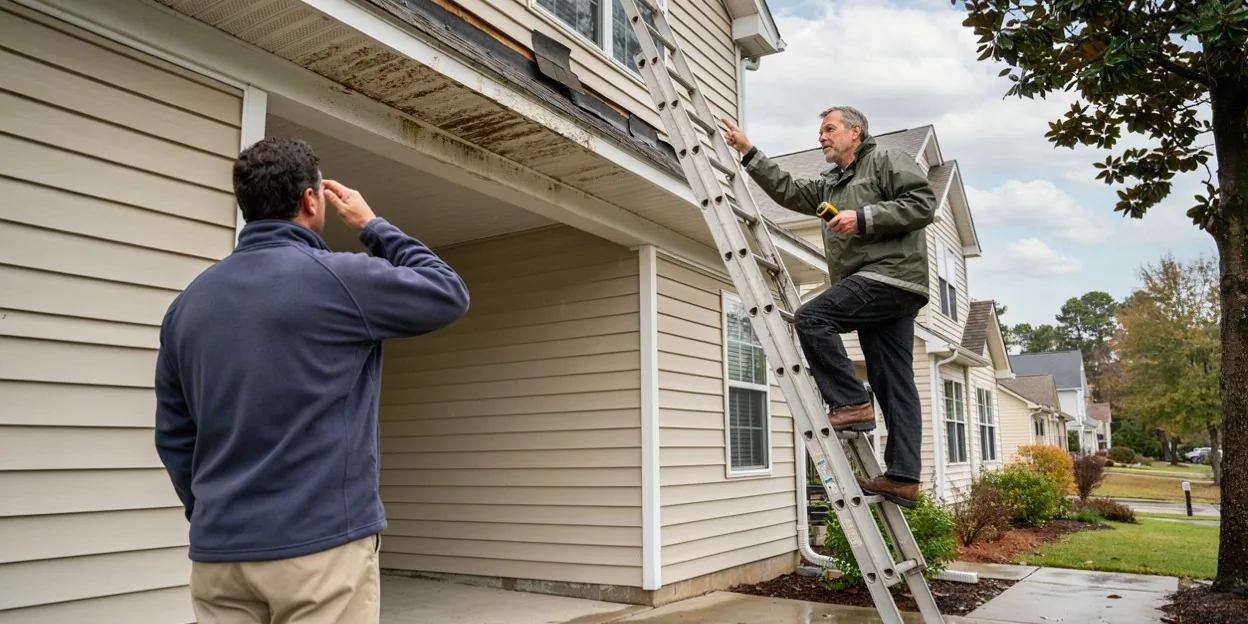
The nor'easter blew for two days out of the east, and on the second night a brown ring showed up on the bedroom ceiling of your Kay Street Victorian and kept growing. By morning the ring had a drip in the middle, and the wall below it was wet to the chair rail. This site puts you through by phone to an independent local provider who dries out houses after roof leaks and ice dams in Newport and across Newport County.
Tracing the water from the ceiling stain back up to the roof
Water rarely comes through the roof where it shows up on the ceiling. It enters at a slipped slate, a failed valley, a chimney flashing, or the back of an ice dam, then runs down a rafter and along the top of a ceiling joist before it finds a crack in the plaster. So the crew starts in the attic with a flashlight and a meter, reads the roof deck, the rafters, and the insulation, and works back to the entry point. Then they read the ceiling from below and the wall the water ran down, all the way to the floor.
Wet insulation comes out first, because it holds the water against the ceiling. Then the ceiling is opened at the low spot if it is holding water, and the drying starts.
Catching the drip without making the ceiling worse
Put a bucket under the drip and a tarp on the floor. If the ceiling is bulging, poke a small hole in the center of the bulge with a screwdriver and let it drain into the bucket, because a controlled hole is better than a plaster ceiling on the bed. Stay out from under a ceiling that is sagging in a sheet. Move furniture and photograph the stain, the wall, and the floor. Do not go on the roof in a storm, and do not go on a slate roof at all. Call the cleanup crew and a roofer both.
What the attic and the ceiling keep
Rafters and the roof deck almost always dry in place once the roof is closed. Wet insulation comes out and is replaced after the drying is done. A horsehair plaster ceiling that stayed attached to its lath is often dried from above through the attic and saved. One that has separated from the lath or dropped comes down and becomes a ceiling water damage repair. The wall below the ceiling is metered at the base, and plaster there is usually dried through small openings rather than cut. After the removal, structural drying runs in the attic and the rooms below until the readings hold.
If the leak has been going on for a season, the crew looks for staining on the framing that says so, and they tell you, because a long slow leak is a different insurance conversation than one storm.
Slate, valleys, and ice dams on Aquidneck Island roofs
Newport's Victorian and Gilded Age houses carry slate roofs that are often a century old, with copper valleys and flashing that salt air has been eating the whole time. A single slipped slate lets a nor'easter's sideways rain straight in, and the east wind off the Atlantic on Ocean Drive and Ochre Point finds every gap. Colonial houses on the Point and Historic Hill have wood shingle or asphalt over old sheathing and steep pitches that shed rain well but hold ice at the eaves.
Ice dams are a winter problem here even though Newport gets less snow than inland Rhode Island. A cold attic over a warm house with no insulation, which describes most of the old housing stock, melts snow from below. The meltwater refreezes at the cold eave, pools behind the ice, and backs up under the slates or shingles and down the inside of the wall. The Blizzard of February 6 and 7, 1978 buried the island and left ice dams on every street for a month. The storms of the 2014-15 winter did the same. Once the ice melts, the slates or shingles often turn out to be sound.
Wind and rain damage from a named storm is often treated as sudden damage under a homeowner policy, and so is an ice dam. Long-term seepage from a roof that needed replacing is often not. Have the crew photograph the entry point and log the readings before the roofer covers it.
Calling about a ceiling that is dripping
Say where the stain is, whether it is dripping or bulging, whether there is snow or ice on the roof, and whether a roofer has been called. Mention a slate roof or a plaster ceiling. Call (401) 560-5802.