Ceiling Water Damage Repair in Newport, RI
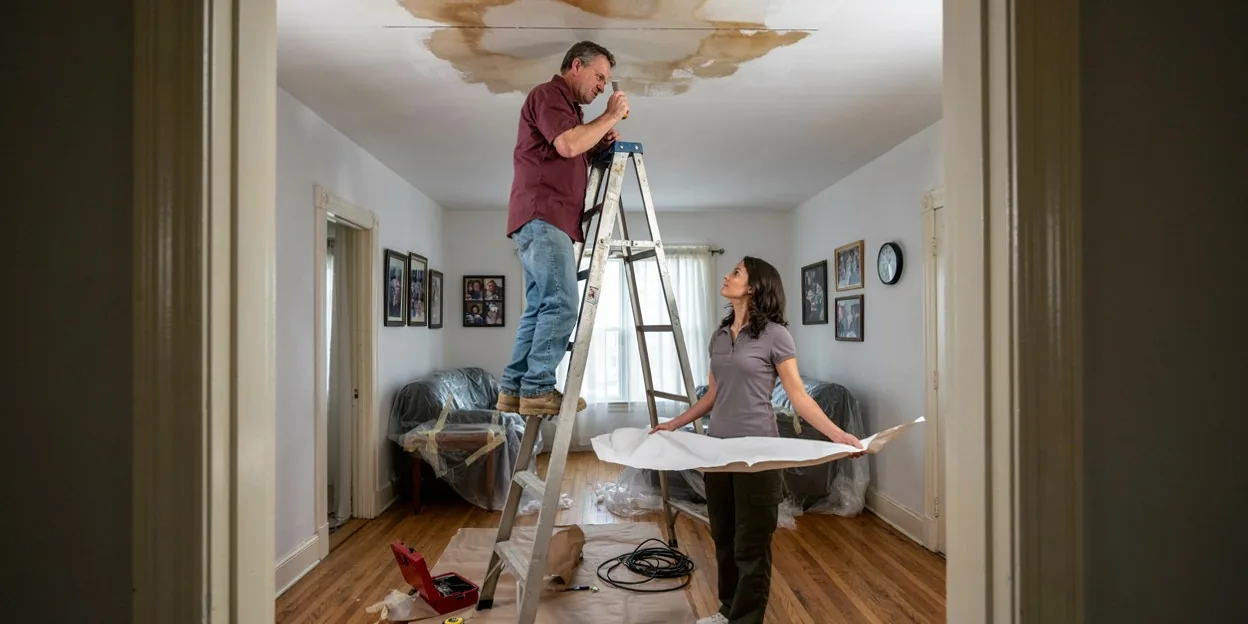
The dining room ceiling in your Broadway three-decker has had a faint yellow ring for a month. Last night the ring turned brown, the plaster in the middle of it bellied down two inches, and this morning there is a pile of horsehair plaster on the table and a hole you can see the lath through. This site puts you through to an independent local provider who repairs water-damaged ceilings in Newport and across Newport County.
Opening the ceiling at the right spot and no wider
The crew reads the ceiling from below with a meter and from above if there is access, then opens it at the lowest point of the wet area so anything still pooled in the cavity drains into a bucket instead of onto the floor. On a plaster ceiling they cut to the nearest joists and stop, because every foot of original plaster that stays is a foot that does not have to be matched later. Wet insulation in the cavity comes out. The joists, the underside of the floor above, and the top of the walls around the room are read and logged.
Then they look for the source. A ceiling does not get wet on its own, and patching it before the leak above is fixed means doing this again.
What to do while plaster is still falling
Get people, pets, and anything you care about out from under it. Put a bucket under the drip and a tarp on the floor. If the ceiling is bulging with water but has not opened, poke a small hole in the center of the bulge to drain it, since a controlled hole beats a collapse. Shut off the water main if the source is a pipe on the floor above. Turn off the light fixture circuit if the fixture is in the wet area. Photograph the ceiling and the floor. Then call.
Saving the plaster where it can be saved
A plaster ceiling that is stained but still tight to its lath is often dried in place from above and saved, then repainted. One that has sagged an inch or two but not separated can sometimes be pulled back and reattached with plaster washers after the drying. One that has separated from the lath or dropped comes down across the wet area, and the lath is checked before anyone puts new material up. The wall below usually took water at the top and is metered too. After removal, structural drying runs in the cavity and the room until the readings hold.
The repair itself, meaning new plaster or blueboard, skim coat, and paint, is usually a separate trade and a separate visit. Ask the provider who does that part and whether they match the original texture.
Where Newport ceilings fail
Newport's housing is stacked. The Fifth Ward and Broadway are two- and three-family houses from the 1880s through the 1920s with bathrooms over kitchens and kitchens over parlors, so a failed toilet supply or a tub overflow upstairs is a wet ceiling down. Historic Hill and the Point have colonial houses where the second-floor bath was added in the 1920s over what used to be a parlor, with plumbing run wherever it would fit. Bellevue Avenue and Ocean Drive carry Gilded Age houses with ornamental plaster ceilings under slate roofs, where a slipped slate or an ice dam shows up first as a stain on a medallion.
Steam heat adds its own leaks. A radiator valve or a return line above a ceiling drips a little every winter for years before anyone notices the ring.
Sources above a ceiling in a Newport house, in rough order of how often the crew finds them: a supply line or fixture on the floor above, a roof or ice dam leak that traveled, a radiator or return line, a failed shower pan, and a window or flashing leak that ran inside the wall and along the joist. A pipe failure is a burst pipe water damage job with a ceiling attached. A roof source is a roof leak and ice dam water damage job. A ceiling loss from a sudden event is often paid under a homeowner policy. A ring that has been growing for six months is often treated as maintenance. Photograph the stain with a date before anything is opened.
Calling about a Newport ceiling that is dripping or bellied
Say which room, whether the ceiling is dripping, bulging, or already open, what is above it, and whether the water main is off. Mention a plaster ceiling or a tenant upstairs. Call (401) 560-5802.